
5G Frequency Bands in Pakistan – Fifth generation mobile technology depends heavily on frequency bands. These bands decide how fast the network is, how wide the coverage will be, and how well signals work indoors. In Pakistan, planning for 5G frequency bands is being handled at the policy and regulatory level, mainly through the Frequency Allocation Board.
This guide explains which 5G frequency bands are available in Pakistan, how they are categorized, and what they mean for real users. The focus is purely on information and understanding, not news updates or commercial details.
What Are 5G Frequency Bands?
A frequency band is a specific range of radio waves used to carry mobile signals. Different bands exist because no single frequency can meet all needs.
In simple terms:
- Lower frequencies travel farther
- Higher frequencies carry more data
- Mid-range frequencies balance both
5G uses multiple bands together so networks can provide coverage, speed, and stability at the same time. The mix of bands determines how practical and reliable 5G will be in daily use.
Available 5G Frequency Bands in Pakistan
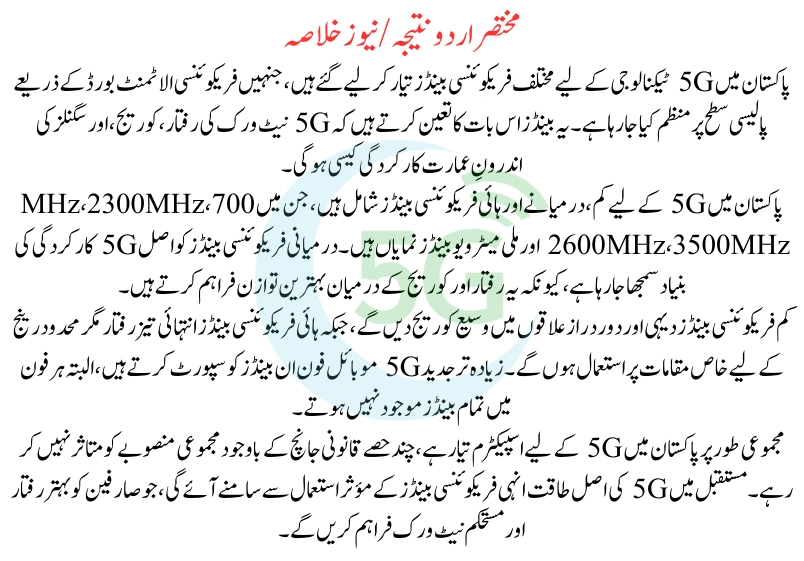
Pakistan has identified and prepared several frequency bands for 5G services. These bands cover low, mid, and high frequency ranges.
| Band | Frequency | Category | Key Feature |
|---|---|---|---|
| n28 | 700 MHz | Low Band | Wide coverage |
| 1800 MHz | — | Partial availability | Limited use |
| n1 | 2100 MHz | Low–Mid Band | Existing spectrum |
| n40 | 2300 MHz | Mid Band | Good data support |
| n41 | 2600 MHz | Mid Band | Very important for 5G |
| n77 / n78 | 3500 MHz | Mid–High Band | Best performance |
| 24–39 GHz | mmWave | High Band | Ultra-fast, short-range |
These bands form the technical foundation for future 5G deployment in Pakistan.
Explanation of Band Categories
Low Band 5G
Low-band frequencies, such as 700 MHz, are designed for:
- Long-distance signal coverage
- Better indoor reception
- Stable connectivity in rural and suburban areas
Speeds are higher than fourth generation but not the fastest possible.
Mid Band 5G
Mid-band frequencies, including 2300 MHz, 2600 MHz, and 3500 MHz, offer:
- A balance between speed and coverage
- Strong performance in cities
- Support for large numbers of users
This category is expected to be the core of Pakistan’s 5G rollout.
High Band (mmWave)
High-band or millimeter wave frequencies operate at very high ranges:
- Extremely fast data speeds
- Very short signal range
- Limited ability to pass through buildings
These bands are best suited for special locations, not nationwide coverage.
Spectrum Status in Pakistan
Around 600 megahertz of spectrum has been prepared or identified for 5G use in Pakistan. Most of this spectrum is available for planning and auction.
However, some portions are still under legal review, particularly within parts of the 2600 MHz band. These matters are being handled through regulatory and legal processes, without affecting the overall 5G roadmap.
The presence of partial litigation does not stop initial or phased 5G deployment.
Are These Bands Compatible With Phones?
Many modern 5G smartphones support these frequency bands, especially:
- 700 MHz
- 2300 MHz
- 2600 MHz
- 3500 MHz
However, not all 5G phones support every band. Compatibility depends on:
- Phone model
- Processor and modem
- Regional variant
Users should always check the supported frequency bands in official device specifications.
Real-World Meaning for Users
For everyday users, frequency bands affect experience in practical ways:
- Coverage will arrive first in major cities
- Urban areas will benefit more from mid-band performance
- Rural areas will rely more on low-band coverage
- Speeds will vary depending on the band in use
5G performance will improve gradually as more bands are added to live networks.
Frequently Asked Questions
Is 5G active in Pakistan?
5G networks are in the preparation phase. Commercial rollout will follow spectrum auctions and network deployment.
Do all 5G phones support all bands?
No. Support varies by device and region.
Which 5G band is the best?
Mid-band frequencies, especially around 3500 MHz, offer the best balance of speed and coverage.
Final Summary
Pakistan has prepared a strong mix of low, mid, and high frequency bands for fifth generation mobile services. While some spectrum remains under legal review, the majority is ready for use.
Mid-band frequencies are expected to drive performance, low-band will expand coverage, and high-band will support specialized use cases. Together, these bands form the backbone of Pakistan’s future 5G network.
